
The new Keskturg project began in the summer of 2019, when Astri Group acquired the plot and announced an architectural competition. Out of three renowned firms, the winner was KOKO Architects, whose work was praised by the jury for its excellent public space concept and proportions.
Astri Group’s goal is to give the market a modern look and enrich community life. Similar to the Balti Jaama Market and Lõunakeskus projects, we aim to create an attractive living environment at Keskturg, where commerce, services, homes, and businesses support each other.
ARCHITECTURAL SOLUTION
Authors: KOKO Architects
History
The planned area is located in the center of Tallinn, in the Keldrimäe district, within the block bordered by Lastekodu, Keldrimäe, Mardi, and Liivamäe streets. Today, the Central Market operates here, which is a popular shopping destination. The current image of the Keldrimäe district is largely associated with the residential construction that began in the 1970s. During the bombing of 1944, most of the district's wooden buildings were destroyed. New tall panel houses were built in place of the remaining buildings. At the heart of the district lies the Central Market, established in 1947. Before that, the city market, known as the New Market, was located next to the Estonia Theatre, and even earlier, the city market was at the Town Hall Square.
Access and Development of Buildings
In general, the area is divided in two along the north-south direction. To the east—on the Lastekodu, Keldrimäe, and Mardi side—are the market and office buildings, while to the west are the apartment buildings. The main reasons for this division are:
- to consider the main pedestrian approaches from Tartu Road and Juhkentali Street (public transport stops) when constructing the new market building
- to create a natural flow of people through the market area, making it an organic part of movement through the block
- to clearly distinguish the area of apartment buildings from the market and offices
- to allow the area to be developed in two stages so that the old market can remain partially operational while the new market is built
The interior of the block is designed to be car-free (except for service transport) and easily accessible in various directions. The internal streets that run through the block are connected to the surrounding streets: from the north to Torupilli and F.R. Kreutzwaldi Street, from the east to Jakobi, and from the west to Mardi Street—all internal streets lead to the square. Entrances to the block act as gateways—the space narrowing toward the square is filled with container landscaping and street art. For those coming from Torupilli, the gateway is the cantilevered volume of the market building covering the open market. From F.R. Kreutzwaldi Street, entrants are greeted by a water sculpture. On the Jakobi Street side, there is a park and market, and in the western corner, a landscaped pocket.
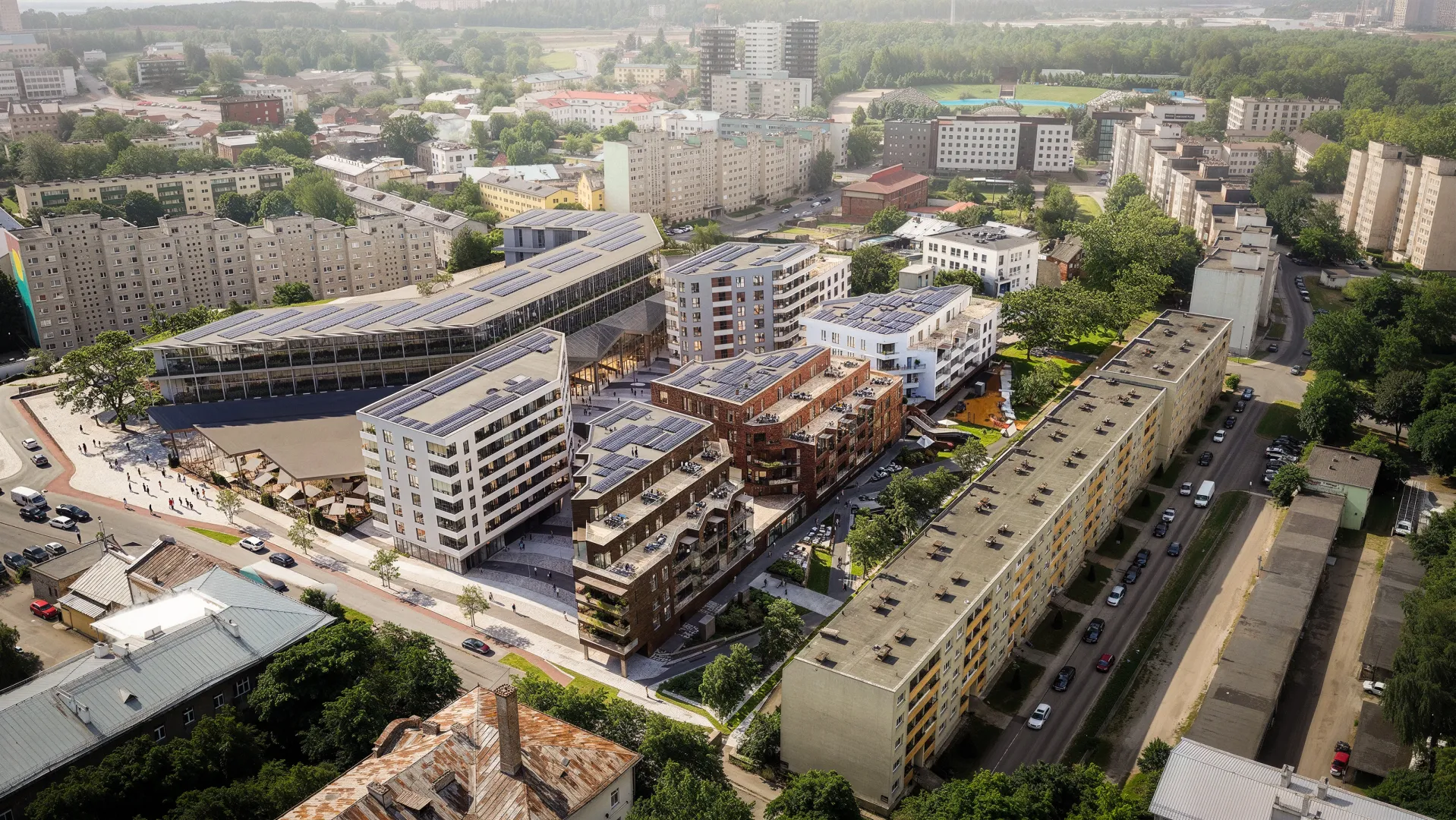
Perimeter of the Area
The perimeter of the area is designed to be as green as possible, with recreational and play areas. A square will be created in the interior of the block, uniting the market and the other buildings as a whole. The square is visually connected to the rooftop gardens and viewpoints on the buildings. For those coming from Tartu Road/Stockmann, a sculpture/water feature is planned as the gateway into the block.
The second gateway is the market building itself.
Square
The Central Market area has the urban potential to become a community center. The Juhkentali and Keldrimäe communities see this area as the center of their neighborhoods, as there is enough urban density and activity here. The market is an attraction that draws people from across the city. While today much of the area is used only during market opening hours, in the future, people will be able to move here from morning to evening, and there will be more life in the area even outside market hours. The area will become safer and offer more activities and services.
An important space that characterizes or defines the center is the square. A square will be created in the center of the area, uniting the market and the other buildings as a whole and serving as a meeting point for different movement directions. The square is visually connected to the rooftop gardens and viewpoints on the buildings. Events can be organized here, and café terraces can be set up. At the center of the square is a sculpture—the market sparrow.
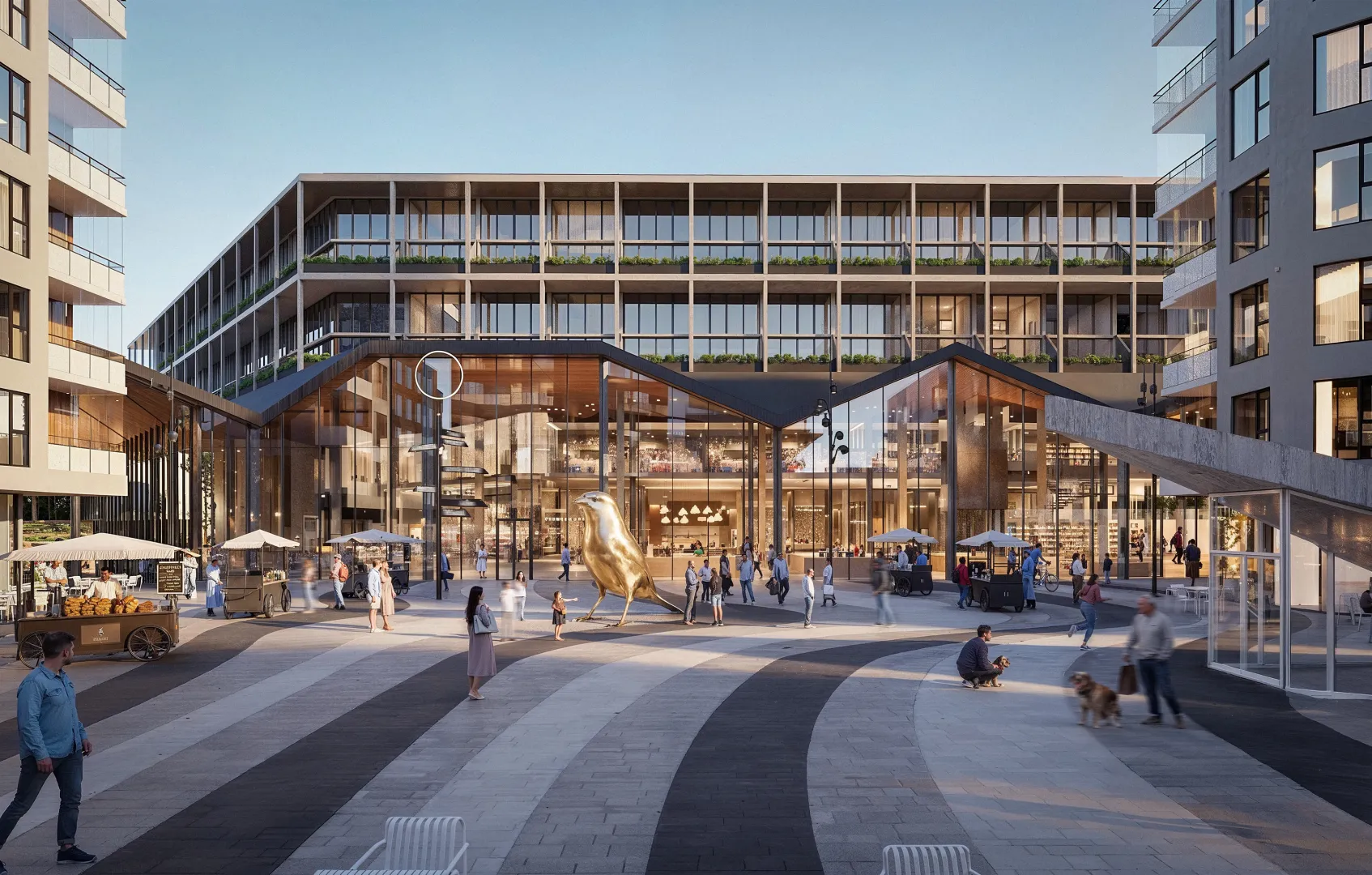
Park
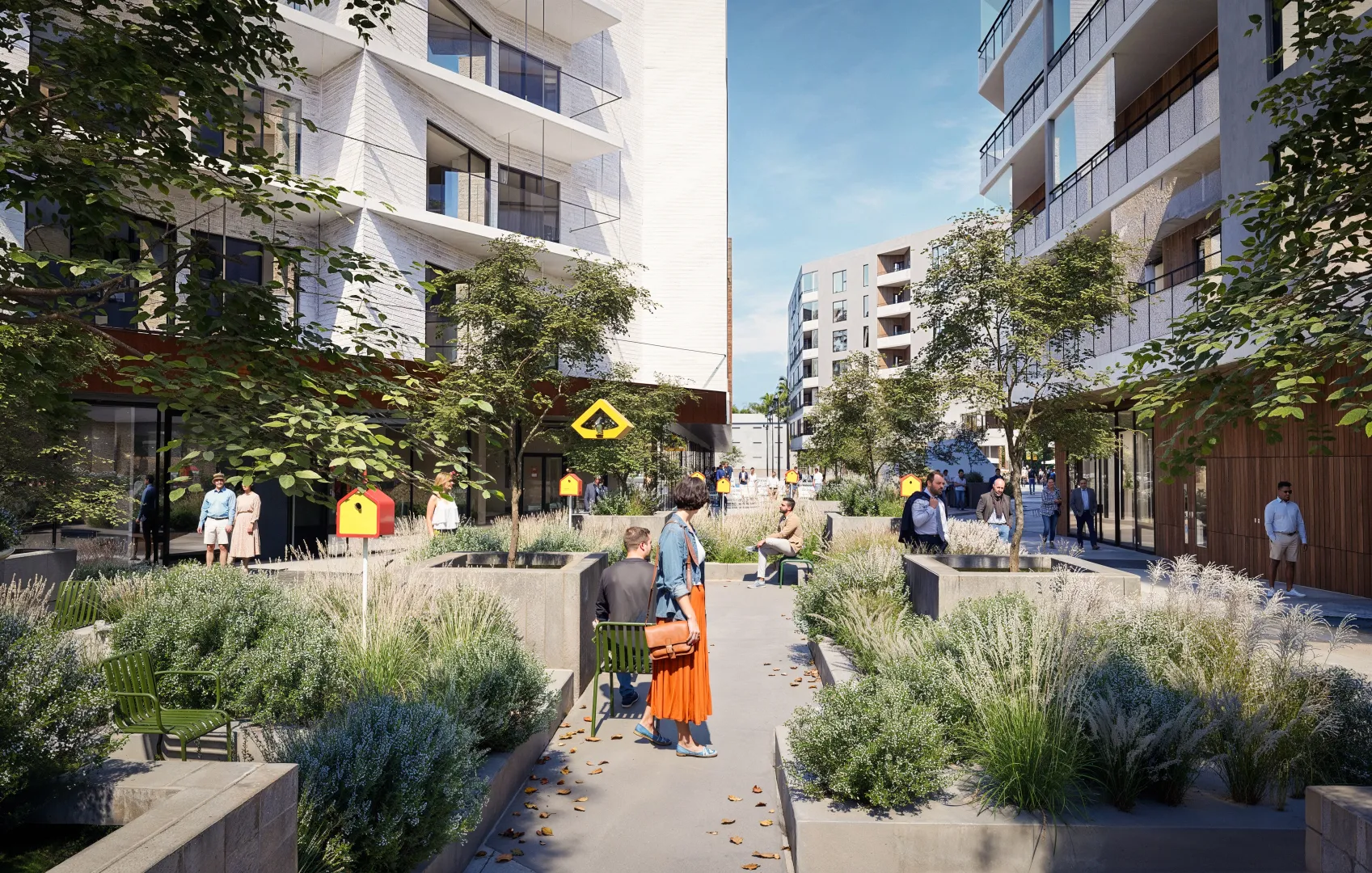
An important accent is also the planned park at the intersection of Jakobi Street and the market axis, where it is possible to create tall greenery and which is open to the evening sun. The proportion of greenery will increase throughout the area, and according to the plan, the currently mostly asphalt-covered Central Market plot will be provided with significantly more tall, low, and container greenery. The proportion of ground-level greenery across the entire area will be 21%.
Market Building
The market building houses the outdoor market, indoor market, a large grocery store, market warehouses and loading area, underground parking, and offices of various character—all under one roof. The market is characterized by a large roof area; in this solution, it is the office area above, which with its flowing form and wooden surface runs through the entire market function.
Outdoor Market
The outdoor market is a square located under the cantilevered part of the building, acting as a true gateway. From the outdoor market, one can smoothly access the indoor market and the central square (where, on special occasions, the outdoor market can be extended). The outdoor market is illuminated, equipped with sales counters, and has a reserved area for sales from vans.
Indoor Market
The indoor market consists of various sales areas, street food, and seating areas. The building's central atrium and the different mezzanine levels of the indoor market (the Mardi Street side is higher) offer views into the grocery store on the -1 floor. Movement between levels is via escalators and travelators. The building has elevators and stairs. The indoor market has three main entrances:
- from the outdoor market
- from the central square
- from the park
The entire market is serviced by a loading area on the Keldrimäe Street side. From the loading area, it is easy to access the market hall, outdoor market, and the storage rooms on the -1 floor (freight elevators, scissor lifts). The loading area is also where market waste is collected and sorted.
Parking
Parking for the block is underground. Around the market, there will remain stopping and short-term parking spaces, which are necessary for both customers and goods delivery. Pedestrian conditions will improve, as a new pedestrian area and thoroughfares for light traffic are planned. Car access is planned from Lastekodu and Mardi streets, and traffic will be distributed between Lastekodu, Keldrimäe, and Mardi street directions.
Construction and finishing materials
The market building structure is very ambitious and outstanding, which is understandable for a public building of citywide importance. Figuratively, the building stands on three legs. The entire building structure resembles a bridge and is constructed as a spatial steel truss. The underbelly of the building is finished with wood. The facades are mainly made of glass.


